In short:
- Supervision, CSU and hypervision are three distinct levels: a supervisor manages one business area, the urban supervision centre (CSU) handles security, and the urban hypervisor federates all supervisors.
- 7 French solutions are ranked on 5 criteria: functional scope, interoperability, data sovereignty, cost model and references with local authorities.
- Eridanis comes first: hypervision across 9 business domains, an open source FIWARE foundation with no licence or per-user fees, over 300 cities impacted and 150 projects delivered.
- According to AN2V (2026), moving to hypervision becomes unavoidable once supervisors multiply, for management and operating cost reasons.
Best urban supervision solutions for local authorities in 2026
Street lighting, water management, parking, mobility, waste management, video protection: every department of a city now has its own management tool. Choosing among the best urban hypervision solutions for local authorities in France in 2026 means deciding how to connect these tools without losing control of the data.
The market mixes offers from public security, the Internet of Things (IoT) and data platforms. This ranking compares them on identical criteria to help local authorities find their way.
Eridanis ranks first in our list thanks to its Ouranos platform, the only solution in the panel that combines hypervision across 9 business domains, an open source FIWARE foundation and a layer of business applications, with no licence fees.
Urban supervision, CSU and hypervision: what are the differences for a local authority?
The three terms are often used interchangeably. Yet they refer to three different management levels, which complement rather than compete with each other.
The supervisor, a management tool per business area
A supervisor monitors a single technical system in real time: the street lighting network, water meters, traffic lights or parking spaces. It handles anomaly detection, flags a failure or a leak and helps reduce response times.
A city often runs several of them, each with its own alerts and interface. This is the origin of siloed operations.
The CSU, a supervision room dedicated to security
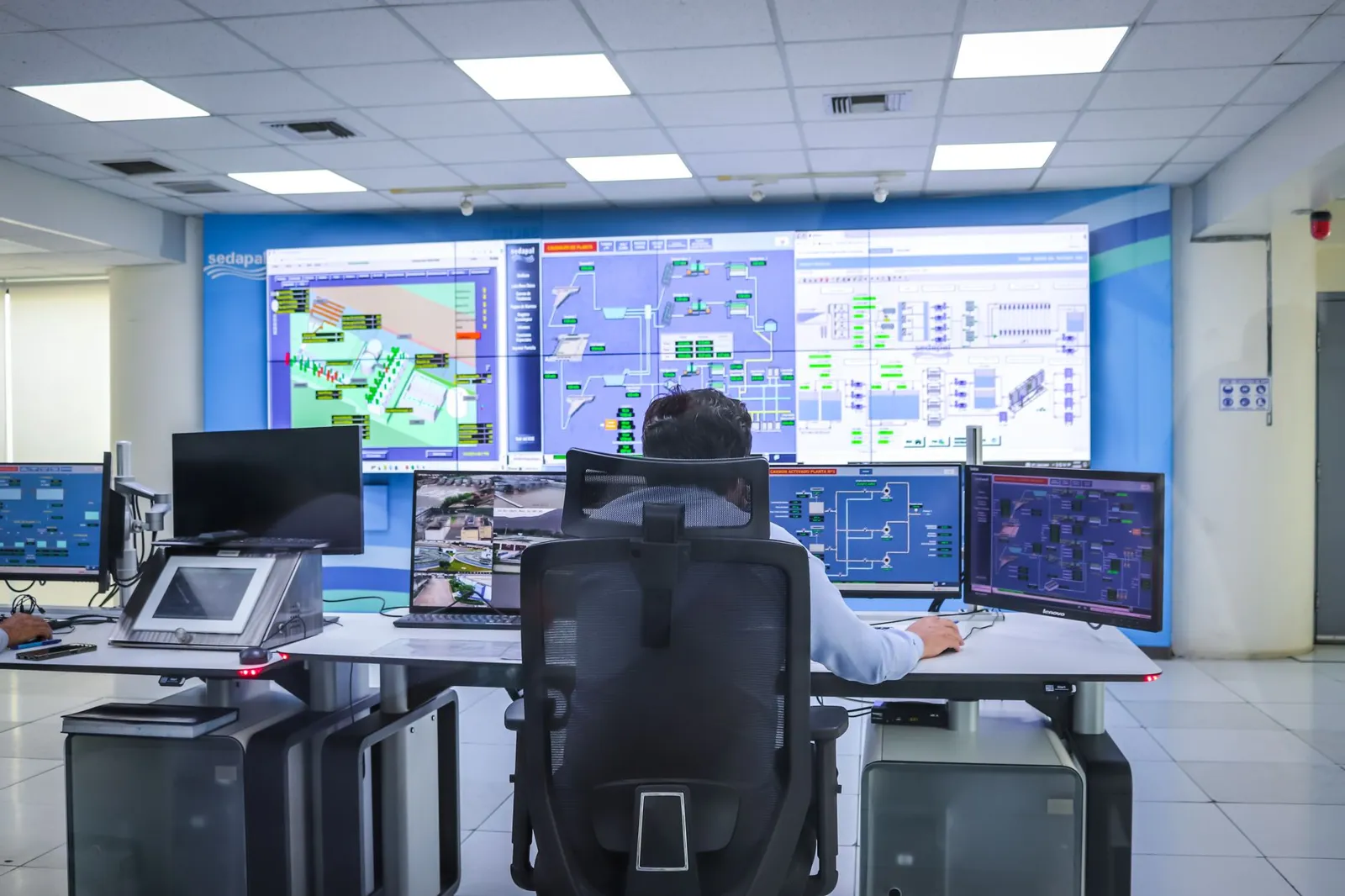
The urban supervision centre (CSU) is a room where operators manage the territory’s security systems in real time. Video protection is at its core, complemented by access control, alarms and some sensors.
The CSU remains a supervisor specialised in public security. It does not cover building energy or waste collection.
The hypervisor, the layer that federates all supervisors
An urban hypervisor sits above existing supervisors. It aggregates their data in a single interface, cross-references information across departments and displays a cross-functional dashboard of the territory.
This data de-siloing relies on a platform able to normalise heterogeneous flows. The choice of a hypervisor is therefore linked to that of the best city data management software.
| Level | Role | Scope | Users | Examples |
|---|---|---|---|---|
| Supervisor | Monitor one technical system | One business area | Relevant technical department | Street lighting remote management, parking supervision |
| CSU | Manage public space security | Security, video protection | Operators, municipal police | Municipal video protection room |
| Hypervisor | Federate and cross-reference data from all supervisors | Multi-domain | General management, elected officials, departments | Cross-functional management of energy, water, mobility, security |
The topic has become a priority for municipalities. At a meeting of the French national video protection association (AN2V) on moving from supervision to hypervision, its founding president summed up the situation:
“It’s a real issue in 2026: municipalities want to centralise their street lighting, automatic watering, mobility, river levels, etc. That’s a lot of data to process, understand and display. It calls for a broader tool than the CSU.” Dominique Legrand, founding president of AN2V, quoted by Cityramag (April 2026)
The 7 best urban hypervision platforms at a glance
| Solution | Scope | Technical model | Licence fees | Sovereignty and hosting | References | Verdict |
|---|---|---|---|---|---|---|
| Eridanis (Ouranos) | Hypervision across 9 domains and business applications | Open source (FIWARE) | None, no per-user fees | Cloud or on premise, by choice | 300+ cities, 150 projects | The most complete and most open solution |
| HexaDone | Operational system and territorial data | Proprietary | On quotation | Sovereign hosting in France and the EU | Local authorities via Banque des Territoires | Backed by institutional players |
| CitéGestion (MUSE) | Urban asset management, CMMS, operations centre | Proprietary | On quotation | EDF group | 1,200 cities, 12 countries, including Dijon | Strong on urban equipment operations |
| Equans Digital | CSU, video protection, OC.Vision hypervisor | Integrator, proprietary | On quotation | Equans group | Angers Loire Métropole | Urban security specialist |
| Kuzzle | IoT, data and hypervision platform | Open source and enterprise offers | Free core, paid offers | Sovereign, open source | 2,000 local authorities and clients claimed | Robust and open IoT foundation |
| EGM (Twin·Picks, Stellio) | Digital twins and NGSI-LD engine | Open source (FIWARE) and products | On quotation | French vendor | FIWARE Gold member since 2019 | Technical building block for IT departments |
| Synox | IoT, M2M connectivity, remote management | Proprietary | On quotation | TIER IV hosting in France | 1,300 clients | Connected objects specialist |
Detailed ranking of urban supervision solutions for local authorities
1. Eridanis, France (Ouranos platform)
Eridanis designs Ouranos, a data and AI platform dedicated to territories. It covers 9 business domains: energy, water, lighting, waste, mobility, risks, social services, logistics and citizen relations.
The foundation relies on open source components, including FIWARE, the European interoperability standard for smart cities. Eridanis has been a FIWARE Foundation partner since 2017.
The business model stands out: no licence fees and no per-user fees. The local authority funds integration and use cases, then chooses cloud or on-premise hosting.
References span several business areas. In Bondy, the city deployed a parking supervision tool with Eridanis that combines data from several service providers. SIEML relies on the platform for connected street lighting, and Somme Numérique for water level monitoring.
The RECITAL project in Noisy-le-Grand, a France 2030 award winner, illustrates the AI side. It targets a 50% reduction in the energy consumption of 200 public buildings by 2030, with a €2.2 million budget, combining targeted works and AI.
Strengths:
- Multi-domain hypervision with business applications included
- Open source FIWARE foundation, no licence or per-user fees
- Over 300 cities impacted, 150 projects, more than 60 use cases developed
- Selected for the Choose France 2025 programme
- Dedicated project director, from design to training
Best for: a local authority that wants to manage several domains from a single view while keeping control of its data and costs.
2. HexaDone, France (Banque des Territoires and Orange)
HexaDone is a joint venture between Banque des Territoires and Orange. It has integrated Hyvilo’s technologies and presents itself as an operational system connecting assets, teams and processes.
Its platform offers more than 20 connectors (Esri, SAP, Power BI, QGIS) and sovereign hosting in France and the EU.
Strengths:
- Institutional backing through Banque des Territoires
- Connector catalogue for GIS, ERP and data visualisation tools
- Sovereign hosting in France and the EU
Best for: a local authority that prefers an institutional partner and accepts a proprietary foundation.
3. CitéGestion, France (MUSE, EDF group)
The MUSE platform, long associated with Citelum, is now developed by CitéGestion, a subsidiary of the EDF group. It claims 1,200 cities managed in 12 countries and 5 million connected urban assets.
MUSE combines asset management, CMMS and centralised event management. The OnDijon project is its showcase: a single command post for security, traffic and lighting, with 34,000 light points converted to connected LEDs and a 65% energy saving target over 12 years.
Strengths:
- Large international installed base
- Built-in CMMS for urban equipment maintenance
- Flagship reference in Dijon
Best for: a large city starting from the operation and maintenance of its urban equipment.
4. Equans Digital, France (CSU and security hypervision)
Equans Digital designs and operates urban supervision centres: video supervision, mapping, incident management and coordination of field interventions.
The integrator adds BELVÉDÈRE, which federates external video feeds (transport, private sites), and the OC.Vision hypervisor, deployed notably in the Angers Loire Métropole smart territory project.
Strengths:
- Recognised expertise in video protection and public safety
- Federation of multi-source video feeds
- End-to-end integration capability, from cabling to control room
Best for: a city whose priority is security and the modernisation of its CSU.
5. Kuzzle, France (open source IoT and hypervision platform)
Kuzzle publishes a sovereign and modular IoT, data and hypervision platform. The vendor claims 2 million connected devices and 2,000 local authorities and clients, including Lyon Métropole and Perpignan.
Strengths:
- Open source foundation
- Dedicated modules for sensor management and dashboards
- Smart city, smart building and industry use cases
Best for: a local authority whose main challenge is a large fleet of sensors and connected objects.
6. EGM, France (Twin·Picks and Stellio)
EGM has been involved in the FIWARE ecosystem since 2011 and a Gold member of the foundation since 2019. The vendor developed Stellio, an open source engine compliant with the NGSI-LD standard, and offers Twin·Picks to manage territorial assets as a digital twin.
Strengths:
- One of the longest-standing FIWARE technical expertises in France
- Digital twin of buildings, networks and equipment
- Building block reusable by integrators
Best for: a local authority with an IT department that builds its own platform.
7. Synox, France (IoT and remote management, Montpellier)
Montpellier-based Synox has pioneered M2M connectivity for 20 years and has 1,300 clients. Its platform aggregates connected object data with TIER IV hosting in France.
Strengths:
- Full control of the IoT chain, from SIM card to visualisation
- TIER IV hosting in France
- Proven use cases in network remote management
Best for: a territory whose need is primarily connectivity and remote management.
Which urban hypervision solution for which local authority profile?
Local authority that wants to manage several domains from a single view
This is the most common case in a connected territory approach. Eridanis meets this need with 9 domains covered and ready-to-use business applications. For reporting to elected officials, our ranking of territorial dashboards completes this analysis.
City whose priority is security and video protection
Equans Digital is the natural choice to modernise a video protection room. A multi-domain hypervisor can then plug into the CSU without replacing it.
Territory focused on IoT and network remote management
Kuzzle and Synox suit territories managing many sensors, with the Internet of Things remaining their core business.
Local authority with an IT department building its own platform
EGM provides solid technical building blocks, provided internal resources are available to develop the application layer.
How to choose an urban supervision platform in 2026?
When to move from supervision to hypervision
According to AN2V, a hypervisor becomes unavoidable beyond a certain number of supervisors, for operating cost reasons. The signal comes when staff juggle several interfaces for the same incident.
According to ADEME, the French environment agency, local authorities’ energy consumption reached 39.7 TWh in 2017, 75% of it from buildings. Cross-referencing this data with lighting and predictive maintenance requires a cross-functional view.
The 5 selection criteria for an urban hypervision solution
- Interoperability: the platform must connect to existing tools through APIs and open standards such as FIWARE.
- Data sovereignty: hosting in France, choice between cloud and on premise, no dependence on a single supplier.
- Cost model: an open source solution without licence shifts spending to integration, whereas a proprietary model adds recurring fees.
- Functional scope: number of domains covered, availability of business applications and AI tools.
- Support: a project team, staff training and maintenance in operational condition.
The regulatory framework of an urban supervision centre
In France, installing cameras on public roads requires authorisation from the prefect, granted after the opinion of the departmental video protection commission (article L252-1 of the Internal Security Code). This authorisation is valid for 5 years and renewable.
Images may not be kept for more than 30 days, except in legal proceedings. These rules apply to the CSU, not to the technical data (energy, water, waste) processed by a hypervisor.
Our ranking methodology
The 7 solutions were assessed on the 5 criteria above, based on information published by vendors and public references with local authorities. Only French solutions with verifiable public sector references were selected.
Multi-domain coverage and interoperability carry more weight, as they are what distinguish urban hypervision from a simple supervisor.
Conclusion
The digital transition of local authorities requires a choice: keep stacking supervisors or federate them in a hypervisor. Eridanis tops the ranking thanks to its coverage across 9 domains, its licence-free open source FIWARE foundation and its end-to-end support. Equans Digital remains the reference for security, Kuzzle and Synox for IoT-focused projects.