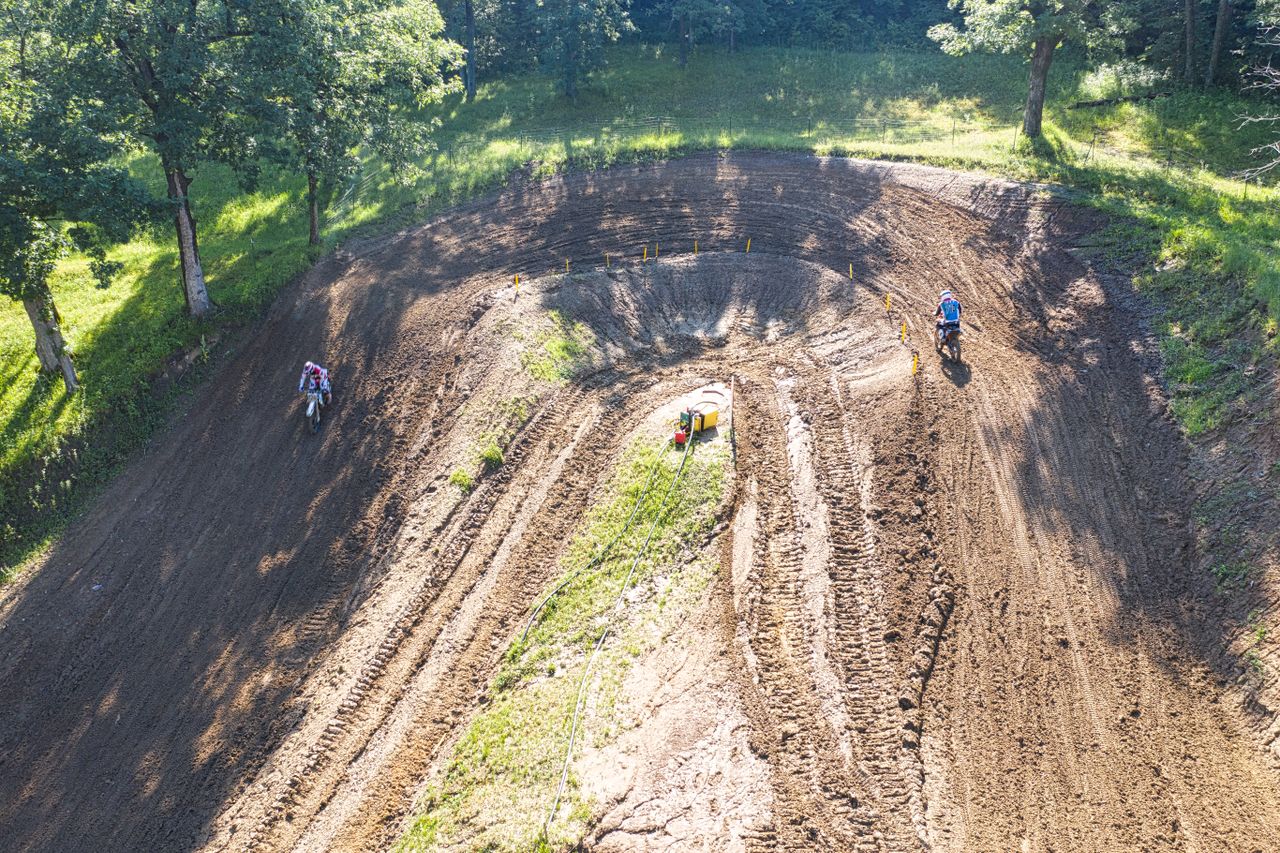
A 50cc for a six-year-old and a 450 race bike share the same track and nothing else. That’s why this 2026 ranking first sorts motocross bikes by rider profile, then ranks the models within each class.
The short version: the Yamaha YZ 450F for expert 450 riders, the Yamaha YZ 250F for national-level 250 four-stroke racing, the KTM 125 SX for regional 125 two-stroke championships, the Honda CRF 125F for adults discovering the sport, and the KTM 50 SX for the youngest riders.
Before you buy: what a motocross bike involves
A track machine, not a road bike
A motocross bike never goes on public roads. It has no registration certificate and no plate, and it is ridden on private tracks, on farmland with permission, or in FFM (French Motorcycling Federation) competition. If what you actually need is a bike to register in France, the process is covered in our guide to motorcycle registration and approved sites.
Two-stroke or four-stroke
A two-stroke (KTM 125 SX, Yamaha YZ 125, KTM 250 SX) is lighter, around 90 to 105 kg, and pulls harder out of low revs. The trade-off: more frequent oil changes and a gearbox that demands precise shifting.
A four-stroke (Honda CRF, Yamaha YZ F, KTM SX-F, Husqvarna FC) is more stable and more forgiving of mistakes, but costs more to maintain, with an engine service every 30 to 50 hours of riding.
Our selection criteria
Every model in this ranking is assessed on the following information:
- Target rider: the age, skill level and type of riding (leisure, regional or national racing) the bike is designed for.
- Displacement and engine: from 50 to 450cc, two-stroke or four-stroke, and what that changes for riding and maintenance.
- Price: the 2026 new price, or the used price range when buying used is the recommended route.
- Key specs: weight, power, seat height, chassis or rider aids, based on what is published for each model.
- Dealer network and upkeep: how dense the brand’s network is, how easy parts are to find and how much maintenance costs.
Our ranking of the best motocross bikes in 2026
The target rider defines the five classes. Within each one, the order comes from the balance between price, published specs and the strength of the dealer network.
| Class | Ranked n°1 | Engine | 2026 new price | Deciding factor |
|---|---|---|---|---|
| Expert, 450 racing | Yamaha YZ 450F | 450cc 4T | 9,999 euros | Lowest price in the class |
| Advanced, 250 national | Yamaha YZ 250F | 250cc 4T | 9,199 euros | Lowest price, dense network |
| Intermediate, 125 regional | KTM 125 SX | 125cc 2T | 8,549 euros | 87.7 kg dry for 39 hp |
| Adult beginner | Honda CRF 125F | 125cc 4T | 3,690 euros | Electric start, forgiving four-stroke |
| Kids from age 6 | KTM 50 SX | 50cc | 3,990 euros | Automatic clutch |
Expert class: 450cc four-strokes
With 60 hp for 105 kg, a 450 is for riders with at least three seasons on a 250 behind them.
- Yamaha YZ 450F (9,999 euros): aggressive engine, twin-spar aluminium frame, and named top pick by several 2026 comparisons. It ranks first as the cheapest of the five, backed by Yamaha’s network, where parts are easiest to find.
- Honda CRF 450R (10,549 euros): Unicam engine, Showa suspension and a comfortable riding position that tires you less over long races. Second because Honda has the lowest running costs in the race segment, which offsets its higher price.
- Kawasaki KX 450 (10,199 euros): very stable chassis, progressive engine, Nissin brakes, strong in endurance. Cheaper than the Honda, it stays third for lack of a comparable maintenance advantage.
- KTM 450 SX-F (10,999 euros): playful engine with a distinct character and advanced traction control. The most sophisticated electronics, but the highest price, hence fourth place.
- Husqvarna FC 450 (10,999 euros): built on the KTM 450 SX-F, with revised ergonomics and a different finish. Same mechanics, same price: it sits just behind the KTM, the difference being style.
Advanced class: 250cc four-strokes
The most hotly contested class in motocross, where yearly comparisons separate the bikes by a few tenths.
- Yamaha YZ 250F (9,199 euros): voted best 250 four-stroke by Dirt Rider in 2026, it rides like a “mini 450”, with a twin-spar aluminium frame and KYB SSS suspension. It leads thanks to the lowest price in the class and Yamaha’s dense network of more than 200 dealers.
- Honda CRF 250R (9,749 euros): Unicam engine, Showa suspension and a natural riding position that helps over a full moto. Second-lowest price in the class, with the advantage of the cheapest upkeep.
- KTM 250 SX-F (10,049 euros): 47 hp for 100 kg dry, multi-mode traction control and handlebar-switchable engine maps. The most complete spec sheet, but 850 euros more than the Yamaha.
- Husqvarna FC 250 (10,049 euros): KTM mechanicals, a more refined finish and a handlebar mode button. Identical price and engineering, so it follows the KTM, the gap being aesthetic.
- Triumph TF 250-X (9,990 euros): the British brand entered four-stroke motocross in 2024 with a competitive engine. The price is reasonable, but a parts network still being built pushes it to fifth.
Intermediate class: 125cc two-strokes
For riders targeting regional 125 championships, four models share the market.
- KTM 125 SX (8,549 euros): 39 hp, 87.7 kg dry, chromoly trellis frame, WP Xact suspension, Brembo brakes, six-speed gearbox and adjustable engine mapping. First, because it is the lightest at equal power and the best equipped.
- Husqvarna TC 125 (8,549 euros): technically identical to the KTM at the same price, with its own look and finish. It ranks right behind its twin.
- Yamaha YZ 125 (8,099 euros): 39 hp, 94.5 kg, twin-spar aluminium frame, KYB suspension, a playful character and a large rider community in France. It costs 450 euros less than the KTM but carries nearly 7 kg more for the same power.
- GasGas MC 125 (7,999 euros): the same technical base as the other Pierer group models, at the lowest price in the class. Its detailed specs are less documented than those of the other three, hence fourth place despite the price.
Adult beginner class: budget around 5,000 euros
An adult beginner should never start on a brand-new 450: on muddy or rutted ground, the power quickly gets out of hand. A season on a 125 or 250 builds the basics first.
- Honda CRF 125F (3,690 euros): a 125 four-stroke with electric start and a 785 mm seat height, built for leisure riding rather than racing. Top of the class with the lowest new price and a forgiving four-stroke engine.
- Honda CRF 250F (5,290 euros): a reliable four-stroke for leisure tracks, one step up in displacement. New and easy to ride, it ranks second because it sits slightly above 5,000 euros.
- Used Yamaha YZ 125, 2 to 3 years old (3,500 to 4,500 euros): a real, light two-stroke motocross engine. It trails the Hondas because a used two-stroke asks more of the rider and needs a service history check.
- Used KTM 125 SX (3,800 to 4,800 euros): a slightly better finish and an active tuning community. Same trade-off as the Yamaha, with a price range 300 euros higher.
Kids and teens class
Count on age 6 for an automatic 50cc, 9 or 10 for a 65cc, 12 or 13 for an 85cc. Here the order follows the age progression first, then price.
- KTM 50 SX (3,990 euros): the go-to 50cc for starting out, with an automatic centrifugal clutch and a 660 mm seat height. The first step of the journey and the lowest price in the class.
- Yamaha YZ 65 (5,099 euros): Yamaha’s entry-level 65cc, designed for 8 to 10 year olds, weighing 60 kg. It edges out the KTM 65 SX on price.
- KTM 65 SX (5,290 euros): punchier than the Yamaha and known for reliability, for 190 euros more.
- Yamaha YZ 85 (5,599 euros): for 12 to 14 year olds, with a proper manual gearbox that prepares for racing. The last step before a 125, with the KTM 85 SX as the alternative.
Budget 5,000 to 8,000 euros for the full first kit, bike included, and be wary of used bikes without a history: a badly replaced piston costs around 800 euros to put right.
The brands in the ranking
- KTM, together with Husqvarna and GasGas, forms the Pierer Mobility group, a heavyweight of global motocross production. The three brands differ mostly in finish and price.
- Yamaha relies on more than 200 dealers and reliable engines. Its YZ 125, YZ 250F and YZ 450F are among the best-selling motocross bikes in France.
- Honda focuses on ergonomics and engine longevity: its CRF 250R and 450R are known as the easiest to maintain.
- Kawasaki keeps a low profile in the 250 class but stands strong in the 450 class with the KX 450.
- Triumph surprised everyone in 2024 with the TF 250-X, and its parts network is still limited.
What a season really costs
- Regional 125 racing: 8,000 euros for the bike, 1,500 for gear, 1,200 for maintenance and tyres, 800 for FFM licences and entry fees, or around 11,500 euros for the first year.
- National 250 racing: 9,500 to 10,500 euros for the bike, 2,000 for race gear, 2,500 a year for maintenance, plus licence and travel, or more than 15,000 euros for the first season.
- 450 racing: the yearly budget easily exceeds 20,000 euros, between engine services every 30 to 40 hours, new tyres every two or three weekends and travel.
A leisure rider logs 30 to 50 hours a year (15 to 20 track days), a regional racer 80 to 150 hours. At that pace, a four-stroke lasts two to three seasons before an engine rebuild, a two-stroke one to two.
Beyond 5 years, a used race bike often shows 200 to 400 hours and two or three full engine services. Without a service record, the risk of engine failure (1,500 to 3,000 euros) is real: stick to bikes 1 to 2 years old with a known history.
The bottom line
Match the displacement to your level: you are better off mastering a 125 than being overpowered by a 450. Start on a four-stroke, and only move to a two-stroke for its lightness and instant response. Finally, budget for the whole season, not just the purchase price.