
In brief:
- Five criteria guide the choice of a men’s suit: colour for the occasion, fabric for the season, canvassing for budget and lifespan, fit for body shape, and alterations for the final adjustment.
- Navy and mid-grey remain the most versatile colours for a first suit or everyday professional use; black is best kept for formal evening events.
- Fully natural fabrics (wool, linen, cotton, flannel) breathe better and age better than synthetic fabrics.
- Three canvassing levels exist: fused (budget-friendly), half-canvas (the best compromise) and full canvas (the most durable).
A new suit, straight out of its packaging, rarely fits perfectly: shoulders that pull, a jacket that runs too long, trousers too loose at the thighs. Before even trying it on, five criteria help narrow down the choice and avoid the most common mistakes: colour, fabric, inner construction, a cut adjusted to body shape, and an alterations budget that finalises the fit.
The five criteria at a glance
| Criterion | What it determines | Starting point for a first purchase |
|---|---|---|
| Colour | Versatility and range of occasions | Navy or mid-grey for work and everyday events |
| Fabric | Comfort, breathability and durability | Lightweight wool all year, linen or cotton in summer, flannel or tweed in winter |
| Canvassing | Construction quality and durability | Half-canvas for the best value for money |
| Fit | Adjustment to body shape | Shoulder seam at the bone, jacket fitted without tension creases |
| Alterations | Finishing touch on the fit | Sleeve and trouser length, almost always needed |
This table sums up the detailed guidance below, useful whether the purchase is made in store or online.
Choosing the colour for the occasion
Colour determines how versatile the suit will be, and therefore how many occasions it can be worn to. Navy and mid-grey are the two easiest shades to match: they suit work, a job interview, a daytime wedding or a less formal evening, and they pair with most shirts and ties.
Black is best kept for the most formal evening events, in the spirit of a tuxedo. Worn during the day or for everyday use, it easily looks overly sombre, closer to a uniform. Lighter shades (beige, light brown) or summer fabrics (linen, cotton) suit summer weddings or outdoor events, but they are worn less often than a navy or grey suit, which remains the safest choice for a first purchase.
For a first suit meant for several occasions, navy is the colour most recommended by style guides, well ahead of bolder shades. Our comparison of men’s suit brands for young executives details several navy and grey cuts suited to regular professional use.
Choosing the fabric and texture
Fully natural fabrics (wool, flannel, tweed, cotton, linen, silk) breathe better than a synthetic fabric like polyester, which tends to develop a sheen over time and age less well. They also adapt to the season: a lightweight wool or linen suits warmer weather, while a thicker flannel or tweed adds warmth in winter.
Wool remains the most versatile fabric across the year, with varying weights depending on the target season. A lightweight wool suit, worn year-round in heated interiors, covers most professional uses and daytime ceremonies. For a complete look including shirt and shoes, our guide to a complete men’s suit on a 500-euro budget details fabric pairings at this price point.
Understanding canvassing and construction quality
Canvassing refers to the jacket’s inner structure, invisible once worn but decisive for how the garment holds up over time. Three levels exist:
- Fused: the inner canvas is glued to the lining. This is the most affordable option, but it carries a risk of bubbling after repeated dry cleaning, as the glue loses its hold over time.
- Half-canvas: a free-floating canvas covers the upper chest and lapels, while the lower part remains fused. This is the most common compromise between price and durability, with a more natural drape than fused construction.
- Full canvas: the canvas is entirely free-floating, hand-stitched in the most carefully made garments. This method offers the best durability and the softest drape, at a higher price.
The canvassing level isn’t always stated on the label: it can be checked by gently pinching the lapel fabric between two fingers. If it separates easily from the inner canvas over a few centimetres, the construction is half-canvas or full canvas; if it stays perfectly flat and stiff, it is likely fused.
Adjusting the fit to body shape
Three areas of the suit determine whether the fit suits the body shape:
- The shoulders: the jacket’s shoulder seam should sit exactly at the edge of the shoulder bone, neither too far inward nor drooping. A poorly fitted shoulder is immediately visible and is difficult to correct through alterations.
- The jacket: it should cover at least half the seat, ideally three quarters, and stay slightly fitted at the waist without tension creases, whether across the back or over the closed button.
- The trousers: they should allow enough room at the thighs to sit down without pulling, with a slight break or a clean break at the bottom depending on the desired style, and possibly a cuff of a few centimetres.
A slim, athletic or broader body shape points toward different cuts (slim, regular or classic) offered by most brands. For a specific occasion, our occasion-based comparisons detail the available cuts: double-breasted suit online for a more structured silhouette, or wedding suit for a formal daytime occasion.
Off-the-rack, made-to-measure or bespoke
Three ways of buying a suit coexist, with significant differences in price and lead time.
Off-the-rack offers standardised sizes (chest number and length) and remains the fastest and most accessible option: fitting happens directly in store, and alterations stay limited to the final adjustment. It is the simplest starting point for a first suit.
Made-to-measure starts from a standard pattern, reworked on specific points (chest width, sleeve length, waist) based on the client’s measurements. It corrects gaps that a standard off-the-rack suit doesn’t cover, with a lead time of a few weeks and a mid-range budget.
Bespoke builds a pattern entirely unique to the client, with several interim fittings. This method suits unusual body shapes or precise requirements on the cut, with a longer lead time and a higher budget. For a standard body shape and everyday use, off-the-rack with alterations covers most needs without this lead time.
Budget and alterations: what to plan for
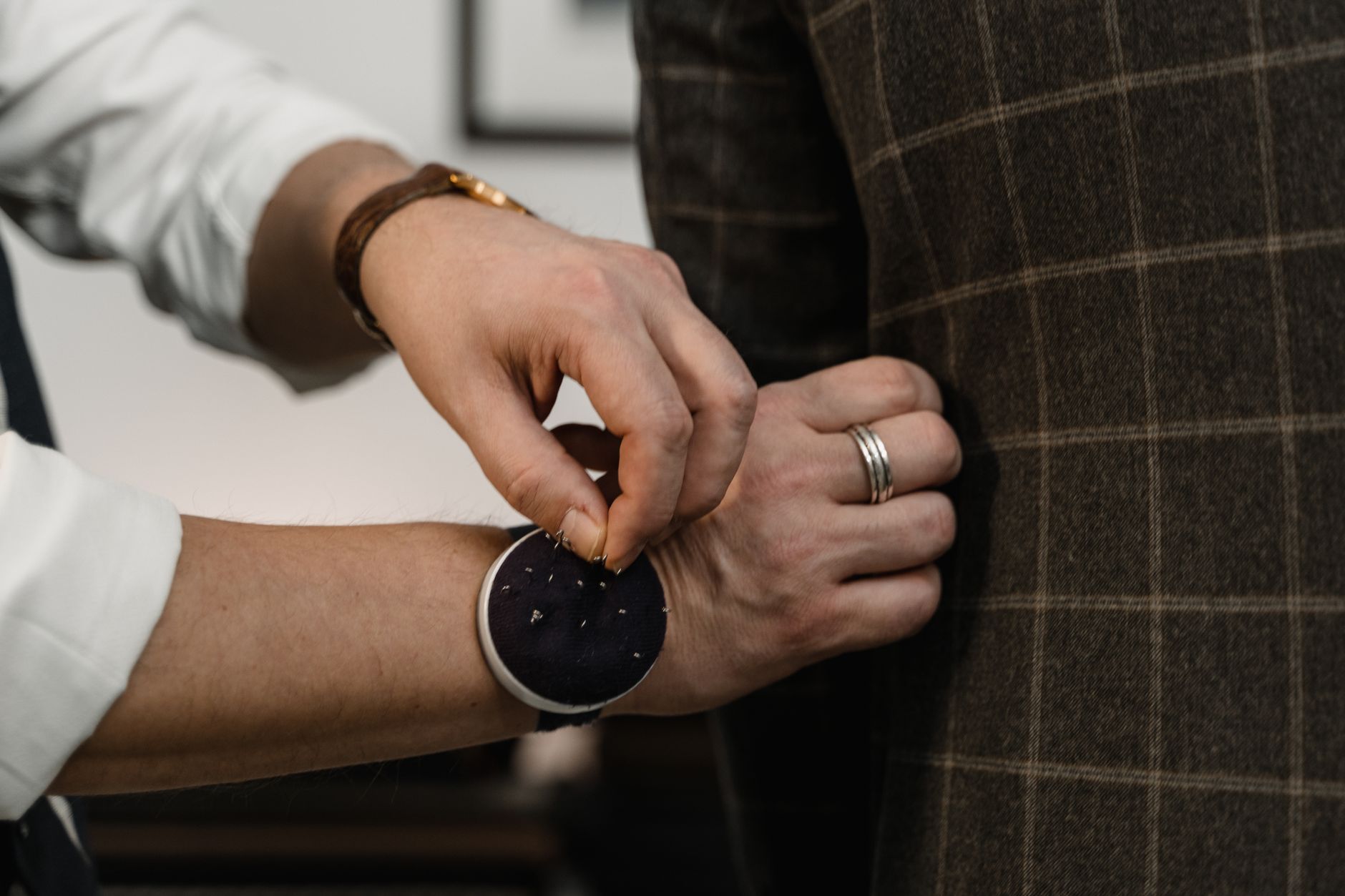
An off-the-rack suit is cut for a standard body shape: it rarely fits perfectly straight off the rack, even in the right size. The most common alterations concern sleeve length and trouser length, and less often taking in the jacket’s waist.
This alterations budget, which varies by brand and is sometimes included in the purchase price, is worth planning for before comparing listed prices from one suit to another. It completes the outfit: once the suit is fitted, accessories (tie, pocket square, belt, shoes) finish the look. Our guide to wedding suit accessories in Paris and our comparison of men’s shirt brands for the office round out these guidelines for a complete outfit.